3 out of 4 Churches Lead to Hell
Blog post description.
2/8/20264 min read
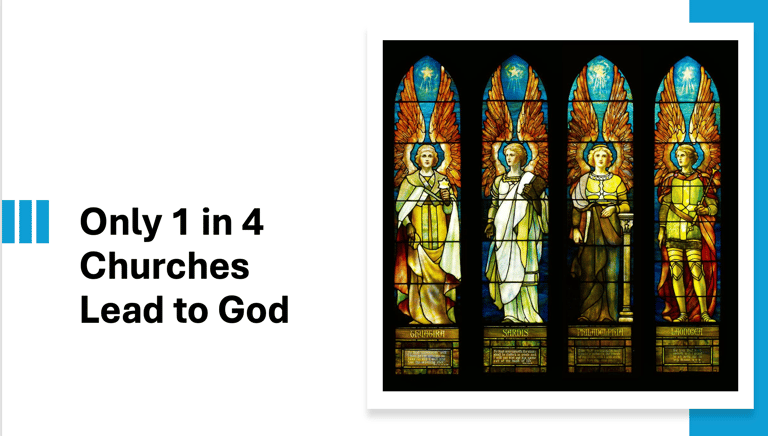
The Last Four Churches of Revelation: A Prophetic Picture of the Church Today
When Jesus addresses the seven churches in Revelation 2–3, He is not only speaking to real first-century congregations—He is also unveiling a sweeping prophetic panorama of church history. While the first three churches (Ephesus, Smyrna, and Pergamos) reflect early stages of the Church's history, the final four churches—Thyatira, Sardis, Philadelphia, and Laodicea—are defined by a dramatic shift.
These last four are not simply historical; they appear to continue alongside one another until the return of Christ. Together, they form a sobering yet hope filled portrait of the spiritual conditions in the Church during the last days.
A Clear Structural and Prophetic Shift
Beginning with Thyatira, the structure of the letters changes in subtle yet meaningful ways.
1. Structural Reversal
In the first three letters, Jesus says, “He that hath an ear, let him hear what the Spirit saith unto the churches” before giving the promise to the overcomer.
In the last four letters, that order is reversed. The promise to the overcomer appears inside the body of the letter, and the invitation to hear comes at the end. This shift signals a narrowing focus: the emphasis moves from the church as a whole to faithful individuals within increasingly compromised churches.
2. Prophetic Continuity
Each of these four churches contains a clear reference to the Second Coming of Christ. Unlike the earlier churches, which seem to pass off the scene historically, these final four appear to exist in different forms until the end of the age.
3. The Remnant Principle
As spiritual decline increases, Christ’s promises to overcomers become more personal and more profound. The picture is one of corporate corruption alongside a preserved remnant of genuine believers—until we reach Laodicea, where even the remnant disappears from view at the corporate level.
1. Thyatira — The Medieval Church
Thyatira represents a church noted for outward activity but inward corruption.
Commendation
Jesus appreciates their works, love, service, faith, and patience. On the surface, this church looks vibrant and active.
Rebuke
Yet they tolerate a figure symbolically called “Jezebel,” who leads believers into spiritual compromise, idolatry, and immorality. This points to a system where pagan practices and false teachings were gradually blended into Christianity.
The Faithful Remnant
Even in the midst of corruption, Christ speaks tenderly to a faithful remnant who have not accepted these “depths of Satan.” To them He says, “Hold fast till I come.”
Prophetic Warning
Those who refuse to repent are warned of great tribulation, revealing that this church system continues into the end times.
2. Sardis — The Denominational Church
Sardis represents a church that has a reputation without reality.
Description
Jesus delivers one of the most chilling diagnoses in Scripture:
“Thou hast a name that thou livest, and art dead.”
This is a church rich in history, structure, and identity—but spiritually lifeless.
No Commendation
Sardis is one of only two churches that receive no praise at all. Their works are unfinished and hollow before God.
The Remnant
Yet even here, grace shines through. There are “a few names” who have not defiled their garments. These faithful believers are promised they will walk with Christ in white.
The Warning
Because of their spiritual complacency, Christ warns He will come upon them “as a thief”—unexpectedly and in judgment.
3. Philadelphia — The Missionary Church
Philadelphia is a bright light in an increasingly dark landscape.
No Rebuke
Like Smyrna, this church receives no rebuke. Though small and weak in worldly terms, it is strong in faithfulness.
The Open Door
They have kept Christ’s Word and not denied His name. As a result, Jesus sets before them an open door of ministry that no one can shut. This shows a church committed to evangelism, missions, and obedience.
The Great Promise
To Philadelphia alone is given this extraordinary assurance:
“I also will keep thee from the hour of temptation, which shall come upon all the world.”
This points to divine protection from the coming global tribulation—a promise uniquely tied to their patient endurance and loyalty.
4. Laodicea — The Apostate Church
Laodicea presents the final and most tragic stage.
Self-Deception
This church believes it is rich, increased with goods, and in need of nothing. Yet Christ exposes the truth: they are “wretched, miserable, poor, blind, and naked.”
Lukewarm Faith
Their principal characteristic is lukewarmness—a mixture of profession and worldliness so distasteful that Christ says He will spue them out of His mouth.
No Corporate Remnant
Unlike the other churches, no faithful remnant is identified within Laodicea as a body. Instead, the appeal becomes intensely personal.
Christ Outside the Church
The most haunting image in all seven letters appears here:
Jesus stands outside the church door, knocking. Fellowship is no longer assumed at the corporate level. Instead, He calls to individuals:
“If any man hear my voice…”
The organized church has shut Him out—but salvation and fellowship are still offered to any person who will respond.
A Prophetic Snapshot of Today
Taken together, these four churches portray the spiritual view of the Church in the last days:
Thyatira – Religious systems rich in tradition but corrupted by false doctrine
Sardis – Churches alive in name but spiritually lifeless
Philadelphia – Faithful, obedient believers with global gospel impact
Laodicea – Prosperous, self-satisfied Christianity that has pushed Christ outside
These conditions do not follow one another in neat sequence—they exist side by side. The question is not simply historical or theological.
The question is personal:
Which church do we resemble?
Christ’s final word to all of them still echoes today:
“He that hath an ear, let him hear what the Spirit saith unto the churches.”