The Three Layers of Early New Testament Evidence: Manuscripts, Versions, and Patristic Citations
Blog post description.This blog explores the extraordinary early evidence for the New Testament, spanning roughly the 2nd through 4th centuries. It examines three complementary layers of textual support: the earliest Greek manuscripts, ancient translations into languages like Latin, Syriac, and Coptic, and the extensive quotations found in the writings of early Church Fathers. Together, these layers demonstrate the New Testament’s remarkable historical reliability and show how its text has been preserved with exceptional continuity compared to other ancient works.
Editor: Dr. William Craig
2/23/20263 min read
The Early Evidence for the New Testament: A Three-Layer Foundation
When we examine the first few hundred years of the New Testament, roughly the 2nd through 4th centuries, the amount of surviving evidence is extraordinary compared to other ancient works.
Scholars typically organize this evidence into three distinct “layers”:
Greek manuscripts (the earliest physical copies)
Early translations (ancient versions)
Quotations from early Church leaders (patristic citations)
Together, these three layers form the basis for understanding the strength of the New Testament's historical foundation, each complementing the others as we move through the evidence.
1. Greek Manuscripts: The Earliest Fragments
For the first three centuries, most surviving copies of the New Testament were written on papyrus. These manuscripts are often fragmentary, sometimes small, but they are incredibly valuable because of their early date.
Within 100 Years of the Originals
There are approximately 10–15 manuscripts (mostly fragments) dated to within a century of the original writings.
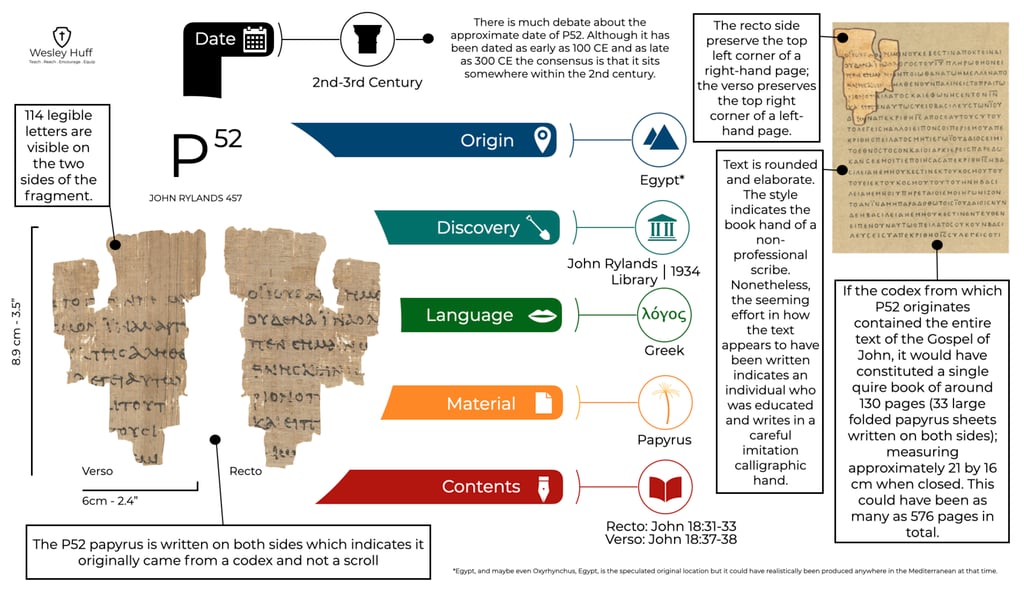
The most famous example is the Rylands Library Papyrus P52, a small scrap of the Gospel of John dated to around 125 AD. Even though it is only a fragment, it demonstrates that the Gospel of John was already circulating in Egypt very early, within decades of its composition.
This short time gap is extremely unusual for ancient literature.
Within 200 Years (By 300 AD)
By the end of the third century, the number of known Greek manuscripts had increased to approximately 48–60.
Some of these are no longer just small fragments but substantial portions of the New Testament. For example:
Papyrus P46 contains most of Paul’s letters.
Papyrus P66 preserves most of the Gospel of John.
These manuscripts allow scholars to compare texts across regions and identify patterns of transmission.
By the Fourth Century
In the fourth century, we encounter the first nearly complete New Testaments in large parchment codices, including:
Codex Sinaiticus
Codex Vaticanus
By this time, the manuscript tradition is no longer fragmentary but fully developed.
In total, from the first 400 years alone, there are roughly 100–120 surviving Greek manuscripts — an exceptionally high number compared to other ancient works.
2. Early Versions: Translations Across the Ancient World
As Christianity spread beyond Greek-speaking communities, the New Testament was translated into local languages. These translations are known as “versions.”
Early Translation Activity
By the late second century, translations had already begun appearing in:
Latin
Syriac
Coptic
These early versions are crucial because they were translated from Greek manuscripts that may no longer exist, providing an independent line of textual evidence.
The Numbers
Across all centuries, there are over 20,000 manuscripts and copies in various ancient languages.
Of those, several hundred fragments and copies come from the first few centuries alone. These early versions confirm that the New Testament text was spreading rapidly across diverse linguistic and geographic regions, such as North Africa, Syria, Egypt, and beyond.
This wide distribution made large-scale alteration unlikely.
3. Early Church Fathers: A Million Citations
The third layer of evidence is perhaps the most astonishing.
Early Christian leaders, often called the “Church Fathers,” quoted the New Testament extensively in sermons, letters, and theological works.
Among these leaders were figures such as:
Ignatius of Antioch
Justin Martyr
Origen
The Volume of Citations
Scholars estimate there are over 1,000,000 quotations of the New Testament in the writings of the Church Fathers.
These citations serve as a massive backup system. Textual critics often say that even if every New Testament manuscript were lost, nearly the entire text could be reconstructed from patristic quotations.
Because these citations come from different regions and centuries, they provide independent control over the Greek manuscript tradition.
Summary Comparison
Here is a simplified overview of the scale of evidence:
CategoryApprox. Total (All Time)Early Evidence (1st–4th Centuries)Greek Manuscripts~5,800~100–120Early Versions~20,000+Several HundredPatristic Citations~1,000,000+Vast majority of NT text
A Note on Quality
As previously stated, many of the earliest Greek manuscripts are fragments, sometimes no larger than a credit card.
Nevertheless, their significance does not lie in their size, but in their age.
Because they are so close in time to the originals, these manuscripts allow scholars to verify that the text has not undergone major or untraceable changes. When early papyri align with later complete codices, it demonstrates remarkable continuity in transmission.
Conclusion
Taken together, early manuscripts, ancient translations, and patristic citations provide a clear, layered picture of New Testament textual history.
For centuries, the New Testament has been supported by abundant, diverse, and early evidence.
By historical standards, this documentation is highly unusual for ancient texts.
Whatever one concludes about its theology, the main point is that the New Testament's manuscript foundation stands among the strongest in the ancient world.
References
Image taken from https://www.wesleyhuff.com/blog/2021/5/6/the-earliest-new-testament-manuscripts