The Unseen World: A Biblical Map of Heaven, Hell, and Everything In Between
Most Christians believe in heaven and hell, but the Bible describes a far richer unseen world than many realize. Drawing from thirteen key biblical terms—Sheol, Hades, Abraham’s Bosom, the Abyss, Tartarus, Gehenna, the Lake of Fire, and more—this article traces how Scripture “maps” the afterlife for both humans and angels. You’ll see how Christ’s death, descent, and ascension literally changed the destination of the righteous, why Hades is only a temporary holding place, how Paradise moves from the underworld to the Third Heaven to the New Jerusalem, and what awaits the lost in the Second Death. Along the way, the piece also weighs popular ideas like purgatory and limbo against the biblical evidence. If you’ve ever wondered what really happens after death—and how the cross rewrote the topography of eternity—this deep dive into biblical topography is for you.
Editor: William Neal Craig, Doctor of Ministry (D.Min.) Candidate in Theology and Apologetics, Liberty University, John W. Rawlings School of Divinity
2/10/20268 min read
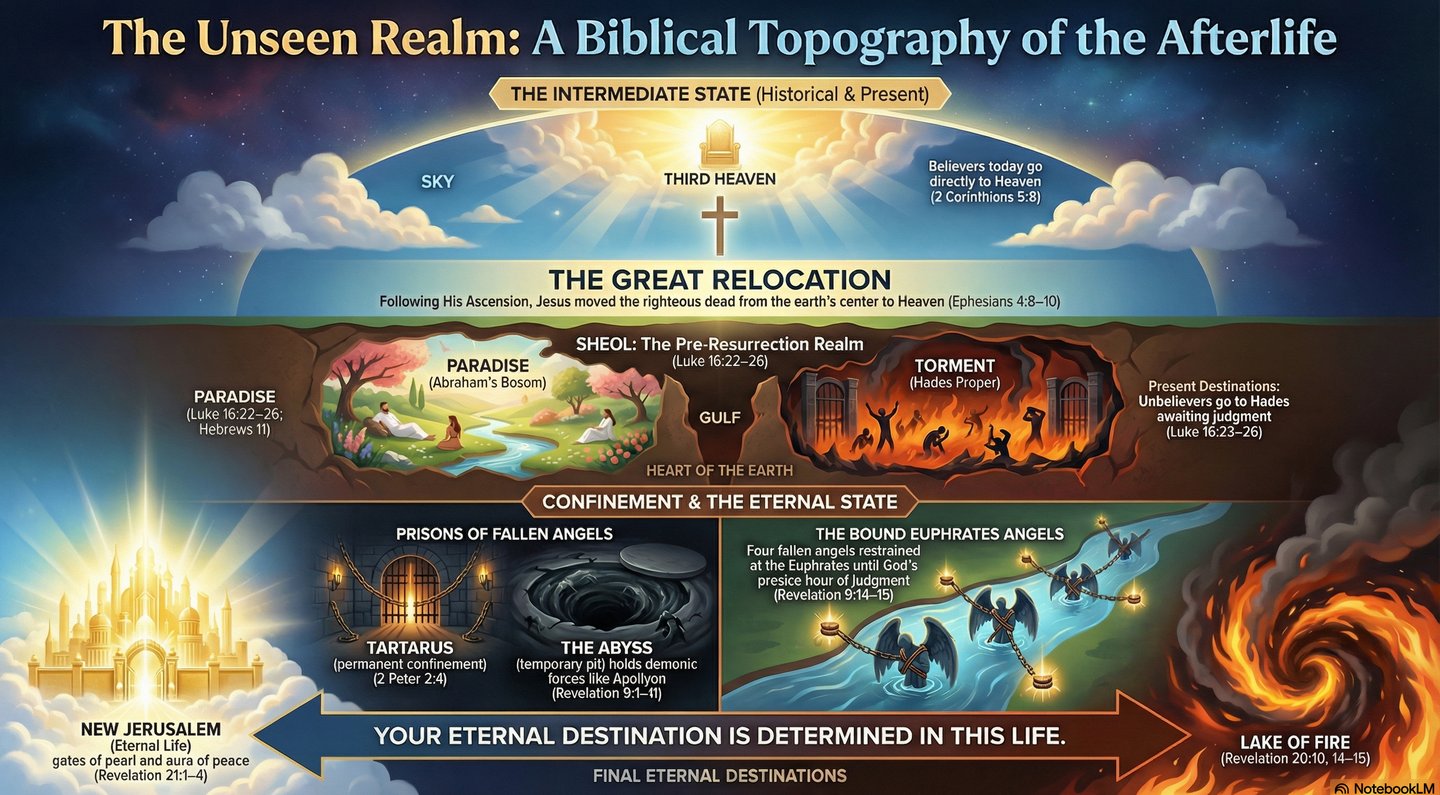
The unseen spiritual realm in Scripture is not vague, poetic language—it is a structured, ordered reality. The Bible describes a topography of the unseen world just as deliberately as it describes the hills of Judea or the Sea of Galilee. Understanding that topography helps us grasp what happens to humans and angels after death, why the Ascension of Christ was such a decisive turning point, and where history is heading in God’s eternal plan.
Mapping the Unseen World: Thirteen Biblical Terms
When you collect all the biblical language about the afterlife and the spiritual realm, a surprisingly detailed “map” emerges. Thirteen key terms outline this unseen topography:
Sheol (Hebrew) – The Old Testament name for the place of the dead, pictured as in “the heart of the earth” or the “lower parts” of the world. All the dead went there prior to Christ’s Ascension—both righteous and unrighteous.
Hades (Greek) – The New Testament equivalent of Sheol. Acts 2’s quotation of Psalm 16 shows Sheol translated as Hades, confirming these are the same location viewed through two languages.
Abaddon – A Hebrew term meaning “Destruction,” used as a proper name for the unrighteous side of Sheol/Hades.
The Pit – A descriptive term for that same unrighteous compartment in the earth’s depths.
The Abyss – A deep, bottomless prison in the unseen realm where certain demons are temporarily confined and where Satan himself will be bound during the millennium.
Tartarus – A special place of confinement for the angels who sinned in Genesis 6; they are held in “pits of darkness” until final judgment and never released.
Hell – In older English usage, a word derived from a root meaning “to cover” or “hide,” used to describe the temporary abode of the unrighteous dead in Sheol/Hades.
Gehenna – From Gei Hinnom, the Valley of Hinnom; in the New Testament it becomes the proper name for the eternal place of punishment.
Lake of Fire – A descriptive term for Gehenna as the final “Second Death” of both men and angels.
Abraham’s Bosom – A name for the righteous side of Sheol/Hades before Christ’s Ascension—a place of comfort and blessing, pictured in Luke 16.
Paradise – A word whose location “moves” in redemptive history: from Sheol, to the Third Heaven, to the New Jerusalem.
Third Heaven – The unseen dwelling place of God, distinct from the atmosphere (first heaven) and space (second heaven).
New Jerusalem – The final, eternal city of God, the everlasting home of the redeemed.
Taken together, these terms show that Scripture doesn’t treat the afterlife as a vague spiritual fog. It speaks of distinct locations, transitions, and judgments. Sheol/Hades originally functioned as a unified underworld, but not a uniform one: it was divided between comfort and torment, righteousness and unrighteousness, with a fixed “gulf” between them.
Before and After the Ascension: A Topographical Shift
The single greatest dividing line in the history of the unseen world is the Ascension of the Messiah. What Christ accomplished in His death, descent, and ascension literally changed where the righteous dead reside.
Before the Ascension: All the Dead Go Down
From Adam until the resurrection and ascension of Christ:
All humans who died—righteous and unrighteous—went down to Sheol/Hades.
Within Sheol, the righteous were comforted in Abraham’s Bosom, a place of blessing.
The unrighteous were held in a place of conscious torment called Hell, Abaddon, or the Pit.
A fixed gulf separated the two; there could be awareness and conversation (as in Luke 16) but no crossing.
Why were Old Testament believers not immediately in the full unveiled presence of God? Because under the Mosaic system, animal sacrifices only covered sin; they did not remove guilt in the final, once‑for‑all sense. The blood of bulls and goats pointed forward to Christ, but until His sacrifice, sin had not been decisively dealt with.
The Three Acts of the Messiah
His Death
On the cross, Christ provided the legal basis for a new arrangement of the unseen world. His blood did what animal sacrifices never could: it truly removed sin for all who trust Him. That means the redeemed are now qualified to be in the immediate presence of God—not just in a compartment of Sheol.His Descent
After death, Christ’s spirit went to the righteous side of Sheol—Abraham’s Bosom—to be with the faithful who had died in hope. From that position, He made a proclamation to the “spirits in prison,” the unrighteous dead. This was not a second chance at salvation but a declaration of victory and the certainty of their coming judgment.His Ascension
When Christ ascended, He “led captivity captive”—He relocated the righteous dead from Abraham’s Bosom to the Third Heaven. From that point forward, believers who die do not descend to Sheol; they go immediately to be “absent from the body, present with the Lord.”
After the Ascension: The Righteous Go Up, the Unrighteous Still Go Down
In the present age:
The righteous depart to Paradise in the Third Heaven, in the presence of Christ and the holy angels.
The unrighteous still descend to the unrighteous side of Sheol/Hades—what we commonly call Hell, a temporary but very real place of conscious torment.
The underworld is now a one‑sided waiting room for final judgment: only the lost remain there. The saved have been moved “up” into Heaven.
Paradise and the Future Home of the Redeemed
The Bible traces “Paradise” through three distinct locations across the storyline of redemption.
Phase 1: Paradise in Sheol (Before the Ascension)
Before Christ’s work, Paradise is a compartment within Sheol—Abraham’s Bosom. It is a place of comfort, conscious fellowship, and hope, but still “beneath,” separated from the full glory of God’s throne.
Phase 2: Paradise in the Third Heaven (Now)
After the Ascension, Paradise is in the Third Heaven. Christ comes from there, and both Paul and John are caught up there in visions. This is where the souls of believers now dwell when they die: with Christ, awaiting resurrection bodies at His return.
Phase 3: Paradise in the New Jerusalem (Forever)
In the Eternal State:
God creates a New Heaven and New Earth.
The New Jerusalem—the great city of God—descends.
Paradise is now fully “on earth,” in that city, as heaven and earth are permanently united.
The journey of Paradise—from Sheol, to Heaven, to the New Earth—mirrors the journey of redemption itself: from separation, to access, to full and permanent union with God.
The Path of the Unrighteous: From Hades to the Lake of Fire
Scripture is equally clear about the destiny of those who die without Christ.
Temporary State: Hades (Hell, Abaddon, The Pit)
Right now, unbelievers who die:
Go to the unrighteous compartment of Sheol/Hades.
Exist as “shades”—fully conscious, in real torment, cut off from God’s favor.
Experience:
Total deprivation of divine blessing
Unending disturbance of soul
Pain in both soul and, eventually, resurrection body
Pangs of conscience
Anguish, despair, and torment
An eternal awareness of judgment
This condition is terrible, but it is not yet the final state. Hades is a holding place until the last judgment.
Final State: Gehenna (Lake of Fire, Second Death)
After the Great White Throne:
The dead are raised.
Hades itself is emptied and then cast into the Lake of Fire.
The lost enter Gehenna, the “Second Death,” the eternal state of separation and judgment.
Here the descriptions intensify:
“Gehenna of fire”
“Outer darkness”
“Unquenchable fire”
“Eternal fire”
“Eternal destruction”
“Furnace of fire”
“Blackness of darkness”
“Second death”
This is not annihilation but an eternal state of conscious existence, separated from God’s grace and goodness, under His just wrath.
Where Angels Are Held: Abyss, Tartarus, Euphrates, and a King Named Abaddon
The unseen world is not only the realm of human souls; it is also the staging ground for God’s dealings with fallen angels.
The Abyss – A deep, prison‑like dimension where certain demons are confined. They dread this place and beg not to be sent there. It is also where Satan will be chained during the thousand-year kingdom.
Tartarus – A unique region where the rebellious angels of Genesis 6 are held in permanent darkness. They do not roam, tempt, or possess; they are locked away until the final judgment.
The Euphrates Confinement – Four mighty fallen angels are bound at the Euphrates, a region pregnant with biblical history (Eden’s vicinity, Babylon’s rise, early human rebellion). They are reserved for a specific time to unleash a catastrophic judgment on humanity.
Apollyon/Abaddon – The “king of the Abyss,” a high-ranking demon who leads a horrific demonic horde. He is distinct from Satan, who still roams the earth for now; Apollyon is confined, awaiting a future release.
This angelic geography reminds us that the unseen realm is heavily policed by God. Evil is real and active, but it is also restrained and directed according to His schedule.
Why Some Traditional Ideas Don’t Fit the Biblical Map
When you overlay this biblical topography with certain traditional doctrines, points of conflict appear.
Limbus Infantum
The idea of a “limbo” at the edge of Hell for unbaptized infants rests on a particular view of baptismal regeneration. Scripture, however, never mentions such a place. It is a theological construction, not a revealed location.
Purgatory
The concept of Purgatory—as a temporary, post‑mortem place of soul‑purging—breaks down on several fronts:
Silence of Scripture – Verses appealed to for Purgatory either describe the testing of works at Christ’s judgment seat or historical judgments in this life, not a refining fire after death.
Internal Inconsistency – Even the main apocryphal support involves prayers for idolaters, which in Catholic theology counts as a mortal sin, sending them to Hell, not to a middle place.
Denial of Christ’s Finished Work – If the Messiah’s sacrifice truly purifies His people, no further purging fire is needed. To add Purgatory is to say, in effect, that the cross was not enough.
The biblical map has no room for a halfway, post‑mortem sanctification chamber. There is a real discipline of believers in this life, and a real evaluation of works in the next, but no purgatorial fire to complete what Christ supposedly left unfinished.
The Final Landscape: New Jerusalem and Lake of Fire
Right now, the unseen world is in a transitional structure. But Scripture is clear about where it’s going.
At the end of the story:
Sheol/Hades is abolished. It is emptied of its dead and then itself thrown into the Lake of Fire. There will no longer be a subterranean holding place.
Two and only two eternal destinations remain:
The New Jerusalem – The radiant city of God on the New Earth, the everlasting home of the Triune God, the redeemed from every age, and the holy angels.
The Lake of Fire (Gehenna) – The everlasting place of judgment for Satan, his angels, and all who rejected God’s grace in Christ.
In other words, the final “map” is simple but sobering: an eternal kingdom of light, joy, and communion with God—and an eternal realm of darkness, separation, and judgment. Every human being is moving toward one of those two places.
Why This Topography Matters Today
This is not mere theological trivia. The biblical topography of the unseen world presses several truths into our daily lives:
Sin is more serious than we think. A universe with Sheol, Hades, Abyss, Tartarus, and Lake of Fire is not soft on rebellion.
Christ’s work is greater than we imagine. Only a crucified, risen, and ascended Messiah could reroute the destiny of the righteous from a holding place in the earth to the very presence of God.
Death is not the end, but a transition. Every person—believer or unbeliever—continues in conscious existence, awaiting resurrection and final placement.
Now is the time for repentance and faith. The map is fixed, the destinations are real, and the cross stands as the only bridge from the path to destruction to the path of life.
The unseen world is not chaotic. It is ordered, governed, and moving toward a final, irreversible arrangement. To know Christ is to be anchored in that coming world, to live now in light of the city that is descending, and to proclaim urgently that there is rescue from the realms of death for all who call upon His name.